
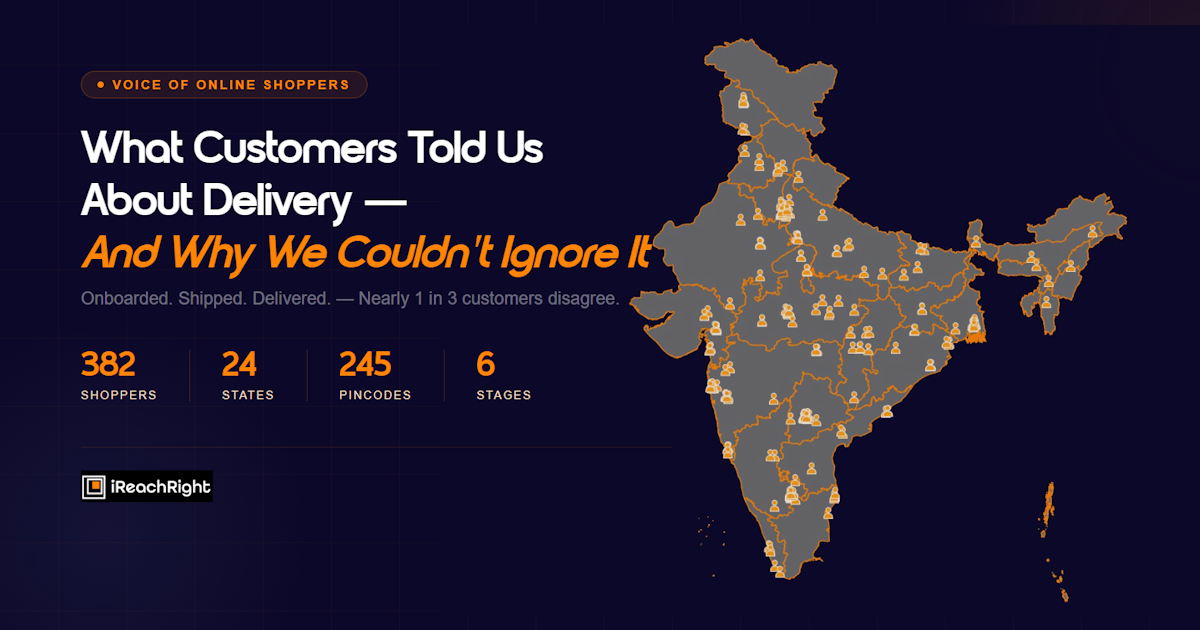
What Customers Told Us
About Delivery —
And Why We Couldn't Ignore It
Onboarded. Shipped. Delivered. — Nearly 1 in 3 customers disagree.
To find answers, we listened to 382 shoppers — 258 men and 119 women, corporate employees, students, business owners and homemakers — aged 18 to 65+, across 24 states, covering 177 major cities and 205 towns, spanning 245 pincodes. Their experiences, across onboarding, dispatch, coordination, delivery, returns and experience — told a story we did not expect.
These voices are from the most recent festive season. The next peak season is an opportunity to get this right.

To understand where delivery reliability actually breaks, we looked at the journey the way a customer experiences it — from the moment they enter an address to the moment the package reaches their door — or comes back. We call these stages:
Onboarding → Dispatch → Coordination → Delivery → Returns → Experience
Behind each of these moments is a chain of three. The merchant who onboards the customer, takes the order and ships — assumes if the pincode is serviceable, the delivery will be done. The logistics partner who picks up and attempts — sets out with the assumption that the location on the map is the same as the customer's address. And the customer — who gives their address to the best of their knowledge, pays, waits, and assumes timely receiving.
Three assumptions. One chain. One question that chain hardly realizes —
To understand if this is true, we went and asked — not to the merchant, not to logistics, but to the customer, who is hardly ever approached.
Onboarding → Dispatch → Coordination → Delivery → Returns → Experience
"App doesn't auto fill the correct address. Every time we need to enter manually."
Customers who correct an auto-suggested address do so because they simply don't trust the suggestion — 63% type manually. These are not careless customers mistyping details — these are people shown the wrong address so often they no longer trust what the system tells them about their own home. Checkout may be faster than ever. The address entering the system may still not be right. What this reveals —
The question that follows —
Onboarding → Dispatch → Coordination → Delivery → Returns → Experience
"My house address has suffix XXX-C and most of the time delivery boys stop at XXX."
88% of customers get their orders delivered at home. After sharing a complete address, they expect the system to know their location. The address was entered carefully. The order was picked up and dispatched. And yet — the agent arrives near the location, but sometimes on the wrong side of the building, sometimes at a completely different one. The address was right. The delivery location was not.
For 6% of customers, this happens every second order or more — not an exception, but a pattern. And there is a reason: studies show that for 45% of locations, mapping technology places the address at least 100 metres away from the actual building. What this makes clear —
~3M orders/day · based on 30M daily deliveries
And that raises the question —
Onboarding → Dispatch → Coordination → Delivery → Returns → Experience
"Delivery person calling despite giving the clear address. It irritates."
So how does the system cope with locations it cannot reliably find? System forces delivery agents to call the customer — this now is the default protocol on reaching a delivery location.
In conversations with delivery agents across cities, we heard the same thing — coordination calls cause them to miss roughly 2 deliveries per day. For brands, that means more agents and harder people management just to deliver the same volumes.
For the customer — 3 in 5 found these calls disturbing, a friction that quietly damages the brand experience with every ring. What this points to —
Which leads to an uncomfortable question —
Onboarding → Dispatch → Coordination → Delivery → Returns → Experience
"Address was correctly mentioned along with pincode but the shipment got redirected to wrong address with part order getting delivered correctly."
Same order. Same address. Same pincode. One part arrived. Another was redirected. The address was not the problem.
No NDR (Non-Delivery Report) dashboard captures this — because dashboards record delivered or not delivered. Not whether this exact address successfully received a delivery last Tuesday. The inconsistency is not in the address. It is in how the location is found — varying delivery to delivery, agent to agent, day to day. What this exposes —
~1.5M orders/day · based on 30M daily deliveries
The question that remains —
Onboarding → Dispatch → Coordination → Delivery → Returns → Experience
"Sometimes it shows the order is delivered, but in reality it's not, and we had to call 5-6 times to get a refund."
The dashboard said delivered. The customer never received it. Proving that gap cost them five or six phone calls.
Nearly 1 in 2 customers have experienced a return without any delivery attempt — at least once in every 5 orders. For 7%, it happens every second order or more. These are customers who waited, received no call, no knock — and discovered the order had quietly gone back.
What gets recorded and what actually happened are not always the same thing. And once that trust is lost, no discount or apology fully restores it. What this confirms —
~3.75M orders/day · based on 30M daily deliveries
The question that cannot be ignored —
Onboarding → Dispatch → Coordination → Delivery → Returns → Experience
"Placed an order from a new brand — after 2 days the courier updated that my area was unserviceable — whereas I stay in Bengaluru city and all other orders were getting delivered."
This is not a remote village. This is Bengaluru. And yet the pincode was blocked.
They did nothing wrong. Their location did not change. A logistics partner made a coverage decision — and a willing, paying customer was turned away before the journey even began. Every blocked pincode is a brand decision made by someone else's algorithm. The customer never knows that. They only know their order did not come — and next time, they may not bother trying. Here is what that decision actually means —
And perhaps the most important question of all —
Following the survey, we reached out to a few respondents — and a few reached back to us. Conversations from Hyderabad, Delhi, Surat, Goa, Hisar, Bhopal, Jhansi, Visakhapatnam, Bilaspur and more. What they said was consistent across every city, every pincode, every experience.
We did not find these expectations unreasonable. But most of them remain unmet — regularly, and at scale.
The gap is not between what customers want and what is possible. The gap is between what the system assumes it has already solved — and what the customer actually experiences.
The delivery chain in India is improving — and that is real. Checkout is faster, networks are wider, and the industry is genuinely working harder. But through all of this progress, the customer's experience remains the most under-measured side of the chain.
The gap today: The findings here do not point to a broken system. They point to a gap — between a geocode and a precise location. Between a serviceable pincode and a delivered order. Between a status update and the truth. Between a customer's expectation and the delivery reality.
For a customer, these issues are frustrating. For a business, they quietly accumulate into operational costs.
The impact: Every failed delivery is a revenue moment lost. Every coordination call is a trust moment spent. Every return without attempt is a customer who quietly decides not to come back. For some, these may be acceptable percentages. For many, they erode the top line and compress the bottom one.
The cost of the location gap: Unresolved locations, returns without attempt, blocked or prepaid pincodes — the cost is not just operational. At an average order value of ₹500–600, even a fraction of these moments translate directly into revenue leakage, customer acquisition cost written off, and retention permanently lost.
The scale ahead: India is building toward nearly double today's scale. Solving the location problem today — and not waiting until that scale arrives — is both an operational necessity and the underleveraged lever for revenue growth and customer experience in Indian e-commerce.
Not a forecast. A mirror:
If the current trajectory continues — at 1 in 10 orders misdelivered, 1 in 8 returned without attempt, and 36% needing coordination calls — the scale of the problem by 2030 will not be because the industry isn't trying, but because the location foundation was not made reliable today.
These are not forecasts. They are a mirror held up to today's gap — at tomorrow's scale.
India solved payments. Logistics networks followed. Checkout got faster. But location infrastructure — the layer that connects a digital order to a physical door — was never the problem being solved.
Most of the visible problems in Indian commerce have found a solution. But one question remains unanswered — do we know where our customers are? The ones we have. And the ones we haven't reached yet.
India is building toward 29 billion shipments by 2030.
How many will find the right door?
And does the system even know?
¹ E-commerce parcels (~14M/day): Economic Times / Redseer, March 2025. 5 billion annual shipments in FY2025 ÷ 365. Read report →
² Quick commerce (~4M/day): Platform disclosed data, March 2025. Watch source →
³ Food delivery (~12M/day): Derived estimate based on 4.4–4.6 billion annual orders projected for 2025, extrapolated from reported growth rates. Sources: IBEF / Kearney-Swiggy 'How India Eats 2025' Read report → and Ken Research 'India Online Food Delivery Outlook to 2025' Read report → Awaiting Zomato / Swiggy FY25 filings for confirmation.
⁴ 2030 projection (24–29 billion shipments annually): Economic Times / Redseer, March 2025. Daily figures calculated from annual projection range. Same source as ¹.